
2024
August 24
Workshop
Nov. 24
Symposium
Nov. 24
Symposium
2025
Nov. 9
Symposium
Dec. 27
Symposium
Dec. 27
Symposium
I would like to share with you my current research about spectral matters, intoxication and decreation.
Last time I was researching in Kyoto, I met professor Yasui Manami and she introduced me to her books on yōkai. At the same time, I was developping artistic residencies in Amazon, where I heard about several entities, especially connected to Indigenous Medicine. It seems in the forest we can also find yōkai.Ghosts, spirits and specters have played vital roles in oral and written narratives throughout history and across cultures.But there is another kind of specters evoking memories, trauma, ethical and political questions.
In general, scholars think about these specters after philosophical and psychological issues.
I would like to propose dancing bodies and movement through a spectrality’s critical scope.
I apologize for the introduction of yōkai, you probably know all about it, but it is important to contextualize the research and my proposal of the spectral turn of butō to deal with the liminalities of life and death.
At first, I thought about Hijikata and Murobushi, who, at some point, had mentioned ghosts and specters in texts and choreographies. But in a second moment, I decided to think about the way these dancers continue haunting other artists.
It is not about the transmission of a dance technique or any aesthetical model, but mostly about the possibilities of dealing with hidden questions through dancing bodies.
A kind of toxic transmission by contamination.
Let’s start with yōkai.
Specters and Ghosts were always present in different cultures. Most of the time, like mystic or religious entities.Here in Japan, they had different names, but now they have been known as yōkai. It takes different forms and are commonly associated with folklore and storytelling around small villages, old cities or deserted mountains …They often appear at twilight and their main characteristic is a certain liminality.They haunt bridges and tunnels, living at crossroads.Yōkai dwell between fact and fiction, belief and doubt.It seems interesting for me that some of the main yōkai appeared where language ends.Mysterious sounds, lights flitting through the graveyard, a feeling that something is watching us in the darkness.
These specters could be spirits, goblins, phantoms, demons, monsters, fantastic beings, supernatural, and many others. Yōkai has become an umbrella term for many mysterious phenomena and weird creatures.In this context, they could be also translated as something danger, uncertainty and terror.In the first part of the 20th century, folklorist Yanagita Kunio (1875-1962) wrote about this subject in his academic writing.
Komatsu Kazuhiko, another great expert on yōkai stories, observes that these specters were always outsiders, and could be understood as an event, a presence or an object. The event is when someone experience something strange, mysterious or weird through the senses.And any of the five senses can play a role in the experience, but the majority are perceived through the eyes and ears.
The second domain is presence. Within the generally animistic worldview that has long being part of Japanese culture, not only do all things possess tama, but also personify the spirits. So they can be angry or sad, grateful or happy.
According to Komatsu the most natural phenomena were attributed to a limited number of yōkai, such as tengu.
And the third realm is object. It could be translated as figure, image, or sculpted item.
The creativity involved in image-making led to a major increase in the number of yōkai. First in scrolls, paintings, ukiyo-e, literature and other supports. And after Meiji in technological apparatus, including films. Professor Yasui has an original approach, talking about the connection between yōkai and the constitution of bodies. It was believed that sicknesses of all sorts were caused by the intrusion into the body of evil spirits and yōkai.
According to historians Kuroda Hideo and Kuriyama Shigehisa, a popular belief held to the early formative years of Japan’s Medieval period, saw the pores of the skin as a primary entry point for sickness. But Yasui is particularly interested in female bodies and female diseases.
She has also studied koema or ema, something like the Brazilian ex-votos. From olden times in Japan, when people felt ill or were injured, the folk religion practice of drawing the afflicted portion of the body on a small wooden board and offering it at a Shintō shrine in hopes of a cure.
There were also amulets in temples. Yōkai can enter and exit human bodies all the time.
Yasui found the four main sections organized by the Daijirin Dictionary: head, torso, hands, and feet. Ears, nose, mouth, vagina and anus are also popular.There were several different ways of representing interior bodies.
Another source is literature. Lafcadio Hearn (1850-1904) wrote Kwaidan (1904) a collection of Japanese stories, that became a horror film directed by Kobayashi Masaki in 1964. He selected four stories:”The Black Hair, “The Woman of the Snow, “Hoichi The Earless, and “In a Cup of Tea”.Tokyo and the IIWW have also remained as a reference to haunted filmography. Oshima Nagisa has filmed experimental performances in Shinjuku’s streets for Diary of a Shinjuku Thief, and Matsumoto Toshio, has filmed Shinjuku’s sex underground, for Funeral Parade of Roses.
Some butō dancers became also interested in spectres and ghosts. Hijikata Tatsumi danced and spoke countless times about the dead, and proposed the corpse as a dancing body. Not only in his dances, but also in films and photographs he created with other partners (Donald Richie, Eikoh Hosoe, among others), the question of spectres always seemed to be present, haunting artists and audience.
Hijikata’s collaborations with Donald Richie, also discussed the imminence of death through corporeal figures and their environments.
This photo is from Human Sacrifice, 1959, directed by Donald Richie and performed by Hijikata Tatsumi
And War Games, directed by Donald Richie in 1962, with the collaboration of Hijikata

In 1969, Hijikata worked with Teruo Ishii in Horrors of Malformed Men, based on a book written by Ranpo Edogawa.

Stephen Barber wrote about
Hijikata’s ghost, focusing in his films

What would be the spectral turn?
In philosophy, the spectral turn is Jacques Derrida’s book Specters of Marx, published in 1993. It is considered the catalyst for marking the appearance of a new area of investigation of which the past decades represent a display of spectrality critical scope. What changed about the critical perception of ghosts and haunting is the recognition of some crises that haunted human culture and imagination. Some examples are related to remains of traumas never solved such as ghostly matters connected to atomic catastrophes, slavery, holocaust and ecological disasters.
Nowadays I would say: Gaza.
The idea I would like to share with you is that butō has also collaborated with this specter turn. Despite the facts Hijikata and Murobushi have talked about ghosts at some point, their dancing discussions were not transcendent but more immanent, which means a more political experience in the sense of giving visibility to haunting questions through dancing bodies.
In the process of evolution, I feel this is also an important trace of butō, not only the mystic representations inspired by Ohno Kazuo. The haunting questions could be understood as a hidden system of knowledge which will be expressed by movement and not necessarily as a discourse. We could think about specter as metaphor, and as something after death as Michael Taussig proposed: the death space of signification. This may be expressed by corporeal movements and not necessarily by verbal language. Wildness is another term that appeared as a death of signification, and the disruption of an order through bodily excess and eccentricity. According to Jack Halberstam and José Muñoz, wildness can be understood as the “spirit of the unknown” and is not a spirit that “belongs” to Indigenous contexts and gets stolen by others for different purposes; rather, it describes the space and the modes of knowing and unknowing that emerge in the encounter between capital and chaos, privilege and struggle, myth and countermyth. Wildness is not the lack of inscription; it is inscription that seeks a mark as evidence of absence, loss, and death. As the specters, wildness can give us access to the unknown. And artists who decided to be there will enter this spectral condition at their own risk.
To deal with this condition, a certain kind of intoxication must be experienced.In this context, intoxication can be a chemical weapon, a metal (mercury for example) and a method of unlearning, as Mel Chen has been proposing.A toxine always change corporeal statesInvading and contaminating bodies.There is no a priori plans conducting the infra-action of toxines They made us need to unlearn about who we were and learn another way to move, to think, and to feel.Therefore, dealing with intoxication as a method of unlearning or a method to decreation, turn to be a strategy to try new movements, including minor movements.Invisible movements.I think about Mercury and Other Metals.
Metal as affect
Disable crip bodies created by Mercury affection . An unlearning method to find new ways of perception by opening the body to unknown realities
I think about Murobushi’s quick silver.
There is a challenge in opening the body to unknown realities. For French philosopher Simone Weil, decreation meant a voluntary suspension of ego and control, to become receptive to something beyond the self. And Italian philosopher Giorgio Agamben developed this further, framing decreation as the deactivation of systems — not to abolish them, but to reveal what they might also be. In many senses I think butō has shown a path of decreation, becoming a spectral turn in the sense of revealing invisibilities through the body and testing communication as a method of intoxication. Something that contaminates and affects bodies, like metals.In order to do so, it is important to deal with visible and invisible materialities.
I would like to share an example of two Nipo-Brazilian choreographers.
Beatriz Sano thought about the materiality of sound and movement, experiencing the possibilities of rhythm metamorphosis. It is song without melody and lyrics.
And Eduardo Fukushima tried a different path, dealing with the imminence of death. This piece is called To Fall.
Let’s see.
Links foe reference
Funeral das Rosas, Toshio Matsumoto, 1969
https://mubi.com/pt/br/films/funeral-parade-of-roses
Navel and A Bomb, Hosoe Eikoh
https://youtu.be/DlgAqjzT3JE?si=KDYyKikc8M-NIPLl
Hosotan
https://youtu.be/ks8bCtAyRUY?si=U3NnxWrwclc2Cgl3
War Games, from Donald Richie
https://youtu.be/NdsRigD7jAU?si=EG1cMDvtBZ9B65v7
Horrors of Malformed Men (1969)
https://youtu.be/-NQYiNPnHQQ?si=3HYE0G3XI7T4bVdQ
Interview with Imamura Shohei
https://youtu.be/lFr3V2S8avE?si=FF0jv_lhkY3W8tBL
Interview with Masahiro Shinoda
https://youtu.be/kmfIFm8qtqo?si=ESMPoJ7qod2hfSc0
Yoshida Yoshihige, Good for nothing
https://youtu.be/yiByEqmSs6E?si=CSIBgjcMGyrtpSWF
Kwaidan, from Masaki Kobayashi
https://www.imdb.com/title/tt0058279/
Diary of a Shinjuku Thief, from Nagisa Oshima
https://mubi.com/pt/br/films/diary-of-a-shinjuku-thief
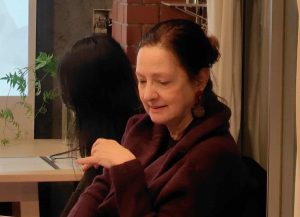
After completing the doctoral program at the Pontifical Catholic University of São Paulo, he conducted research upon invitation from several institutions, including Kinki University, the International Research Center for Japanese Studies (Nichibunken), Rikkyo University, the University of Tokyo, and New York University. Since 2010, she has been a senior researcher at CNPq. She is currently a Professor in the Department of Body Language at the Pontifical Catholic University of São Paulo, where she also serves as Director of various projects and research centers, including the Center for Oriental Studies and the Body Reading Series.