July. 29, 2025
Symposium
Singularly indefinable diseases
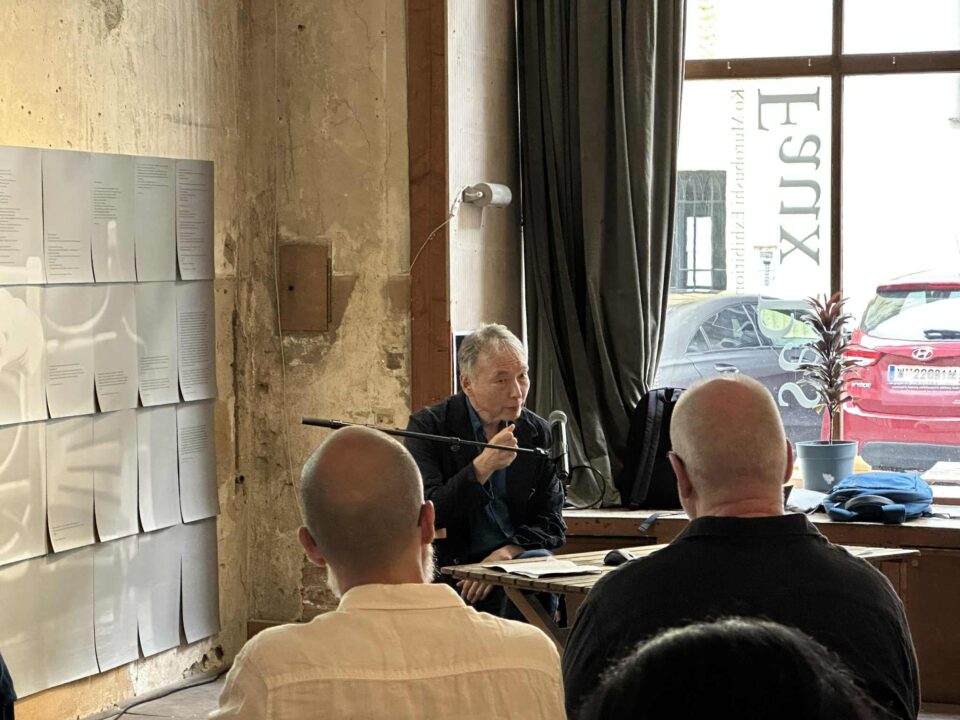
Kuniichi Uno
1
Who here doesn’t know Antonin Artaud? In any case, I’d like you to remember the name Artaud on this occasion, since some Japanese dancers were deeply interested in him. The creator of Butoh, Hijikata, and Murobushi no less, and Kasai Akira, were very sensitive not only to the idea of theater that Artaud launched, but also to the singularity of his thoughts, his writing. It was in a very accurate and interesting context, which we should remember today, that they were inspired to rethink dance, the body, and performance, far from the clichés and myths of avant-gardism, which was so powerful in an era. Moreover, we don’t know if the word avant-garde or avant-gardism still has any meaning for us, for you; that’s a question.
I would like to remind you of two illnesses that Artaud described in a very interesting way in his writings: the plague and his very personal illness in terms of his crisis of thought. I will not dare to speak here of his schizophrenia, which was a major later experience and which was recorded in his four hundred notebooks, the essence of which is inseparable from these two illnesses. So, let’s move on to our urgent subject.
We can remember him, no doubt, as the author of an important book, “Theater and Its Double.” The title already sounds peculiar. What does “double” mean? “Double” is already a strange and very subtle word in the context of his thinking. And for those interested in the theater he proposed as renovating, or even revolutionary, that very term would be unforgettable: “Cruelty.” There is an equally or more important concept of Brecht: Verfremdungseffekt, and like that, cruelty signifies an aesthetic of rupture, or the very rupture of what aesthetic is in theater. We know at least that cruelty signifies the rupture with the representation, the psychology, the narration that dominated theater. Far too much has already been said about this rupture, about what is essential to it, no less than what blurs the essential. Dance has inevitably never been intact from this rupture. And our subject will ultimately be dance.
Of course, tragedy since antiquity has already revolved around cruelty; love is cruel, death is cruel, war, revenge, incest, and destiny are cruel. Without cruelty, there would be no theater; cruelty is an eternal return for theater. Even a comedy is not without cruelty. Artaud referred to a Marx Brothers film as an authentic, sublime example of cruelty. Undoubtedly, too much has already been said about the cruelty Artaud proposed to the theater; however, we can, we must, endlessly ask this question of cruelty, since it is endless outside of theater and within theater. To discuss the theater that he designs and clarify the question of cruelty, his remarks touch on metaphysics, alchemy, Balinese (and therefore oriental) theater, the problem of language, and certain athletics, etc. But above all, the opening text, “The Theater and the Plague”(1933) is already the most surprising and provoking.
“Whatever may be the errors of historians or physicians concerning the plague, I believe we can agree on the idea of a malady that would be a kind of psychic entity and would not be carried by a virus.”(18) Thus, It’s not even a microbe, so it’s not even caused by contagion. “Everything proclaims an unprecedented organic upheaval.” (19) But it “most often indicates that the central life has lost none of its strength, and that a remission of the illness, or even a cure, is possible.” So, is The Plague purely fictional as a theater? Anyway, he continues: “Everything indicates a fundamental disorder of secretions. But there is neither loss nor destruction of matter as in leprosy or syphilis. The intestines themselves, which are the site of the bloodiest disorders of all, and in which substances attain an unheard-of degree of putrefaction and petrification are not organically affected.” (20) “The only two organs really affected and injured by the plague: the brain and the lungs are both directly dependent upon the consciousness and the will” (21). In short, the plague, which “would be a kind of psychic entity,” does not destroy the matter of the body, it does not affect it organically. And all this demonstrates “the spiritual physiognomy of a desease.”(22) For Artaud, the plague is not a mental illness, but rather it primarily affects the localized body, chained to the mind. It acts on the knots between mind and body, not at all on matter or the organism directly. And like the plague thus defined, theater must work on the soul of a spectator exactly in this way. This is how, says Artaud, Saint Augustine was able to blame the plague and the theatre for killing life without destroying the organs and for “provoking the most mysterious alterations in the mind”.
Here, neither for Artaud nor for us, is it a question of saying something plausible in the context of modern medicine. It is to tell you that Artaud invents a disease that could correspond to a theater to be reinvented, to be rediscovered by renewing it. This illness is not a mental illness, but it affects the mental depths (spirit or soul). It leaves matter and organs intact, but it affects the body (as “everything announces an unprecedented organic storm”) and especially affects the parts of the body close to the spirit (brain and lungs). It acts, in a way, especially on life without organs. And “without destroying the organs.” It is as if this illness itself, in its entirety, is neither physical nor organic, but perhaps spiritual, anyway it is not a psychosis. Hence a strange “Gratuitousness” that appears through this scourge and the theater that corresponds to it.
“If a mighty scourge is required to make this frenetic gratuitousness show itself, and if this scourge is called the plague, then perhaps we can determine the value of this gratuitousness in relation to our total personality. (…) Everything in the physical aspect of the actor, as in that of the victim of the plague, shows that life has reacted to the paroxysm, and yet nothing has happened.” (24) The plague is only an illness of this strange life that is outside the organs, freed from the organism. This liberation is also described as “frenzied gratuitousness,” as if nothing had happened.
2
Here we must remember that before this thought on the plague and the theater, Artaud was already suffering from a strange, equally indefinable illness. And this time he truly suffered from it himself. It is another illness, but there are at least some remarkable affinities regarding the “symptoms” of the Plague. He says in his published correspondence with Jacques Rivière (1924): “My thought abandons me at every level. From the simple fact of thought to the external fact of its materialization in words.” “It is a question of (…) a total absence, a real extinction” (31). It is true that the one who says these sentences so eloquently states this loss, “this complete nothingness,” and he demands the absolute right to express “the substance of my thought,” the right to “continue to think” even in paralysis. In another letter, he elucidates his “case” more closely, attributed “to a central collapse of the soul, to a kind of erosion, both essential and fleeting, of the thought, to a temporary non-possession of the material benefits of my development, to an abnormal separation of the elements of thought,” and so on. He points out what diminishes his “mental tension,” which “gradually destroys the mass of my thought in its substance.” (34-35)
According to the great Descartes, everyone thinks, even an idiot. Descartes is someone who discovered an idiot who thinks. Artaud instead discovers a malfunctioning thinking machine that has broken down; thought is a machine that may not function, or a pure intensity that may fall to zero.
Artaud thus launched a strange theater of fleeting thought in decline, with this strange thinking machine in crisis. “Restore to my mind the concentration of its forces, the cohesion that it lacks, the constancy of its tension, the consistency of its own substance.”(35)
Regarding the plague, he emphasizes its psychic entity, which affects neither matter nor organs, despite its overwhelming force that disrupts life to the point of death. Here, in this illness of Artaud, a young, unknown poet, the crisis crosses his soul and his body: “that I am not in the world, and it is not a simple attitude of mind.” “The poison of being. A veritable paralysis, A sickness which deprives you of speech, memory, which uproots your thought.”(45)
The poems written by Artaud faithfully record this disorder, this chaos in thought; they are already a seismograph, a nerve-meter, as he puts it. The mind, caught up in the organic storm, still knows how to function outside of life, outside of the world. This strange illness from which Artaud truly suffers, but through his own in-depth diagnosis and observation, will be reinvented as a kind of theater of thought. It is almost the opposite of the plague in theater, whose strange symptoms we have already noted. In any case, for this thinker-poet, there is no question of giving form, coherence, or balance to his poems, which already work the ice that petrifies thought and the whirlwinds that overwhelm it.
“Never, when it is life itself that is leaving…”, Artaud, in the preface to The Theater and Its Double, very soon raises the question of life, speaking of “this generalized collapse of life.” “The most urgent thing is to extract from what we call culture (and therefore theater), “ideas whose compelling force is identical with that of hunger.” (6) What can theater do for starving children in the world? This is not Artaud’s question. Rather, we must rediscover the forces of hunger in theater. This would not be a very convincing answer. But what is at stake is “our simple force to be hungry.” All culture is nothing but the forms of life. And it will be necessary to empty life of forms and to do this, to dig it down to hunger, to empty matter and organs. No doubt, to “brutalize forms” and to find behind these forms, what survives the forms. We must not dwell on forms: “when we speak the word life, it must be understood we are not referring to life as we know it in its surface of fact, but to that fragile and fluctuating source which forms never reach.” (13) There are always these lived sinuosities of intense and subtle movements between forms, between organs.
For his grand project of theater, to be found and rediscovered in favor of this formless life, against forms. It will be necessary to move to the zero degree of forces to get rid of forms, to reconstruct scales of intensities everywhere. And if theater is reforged as a language, “the important thing is to create the stages and perspectives from one language to the other. The secret of theater in space is dissonance, dispersion in timbres, and the dialectical discontinuity of expression.” Cruelty consists in these nuances, these perspectives.
3
Hijikata Tatsumi, the founder of Butoh, was very sensitive to these inventions of Artaud, especially about strangely indefinable illnesses, of a spiritual nature, but still, not psychopathological, nor material, nor physical, somehow inorganic. The plague as a double of the theater, and its crisis of paralyzed thought, are traversed by inorganic signs, of an inorganic life. Hijikata discovered in Artaud this experience of an impossible state of thought and the invention of the equally impossible theatrical plague.
The unique book entirely conceived by Hijikata, Sick Dancer, is a singular and endless search for materials, gestures, and images of dance. Overall, these are endless descriptions of what a child in a village in northeastern Japan sees, smells, looks at, captures, and touches. Trivial, insignificant gestures of old people and sick women are often objects of intense observation. The villagers, small objects, the winds, shadows, animals, and insects present themselves as signs of dance. They begin to dance within the child’s body. These are therefore not memories of childhood. Certainly, everything is memory, but it is the present doubled with memory, the past redoubled by the present. What is danced as a gap, as a double, as a mirror in time: remembering, observing, telling, dancing are all done simultaneously, but always with gaps, as if these gaps presented themselves as another material for the dance to be sought, explored, and realized.
Those interested in dance primarily in beautiful, sophisticated, powerful, and impressive forms would not agree with what I say, but I would like to say that in this sense, Hijikata’s art, his Butoh or Ankoku Butoh (Dark Dance)is fundamentally anti- form, singularly Mannerist, not in the sense of mannerism.
This dance of the body rooted in the earth, the air, and the history of Northeast Japan focuses on some organic density intimately experienced in an immense life of nature. But everything Hijikata meticulously describes is not captured in nostalgic distance. The particles, the vortices, the vibrations are present, in an extraordinarily close, raw, and meticulous sensation. So much so that everything organic is decomposed and crystallized into the inorganic. It is as if an immense organic life were rediscovered within an inorganic entity.
4
But not all dancers have adopted Hijikata’s dance, seeking in this direction. Who is the authentic successor is not a problem. There are some who have managed to reinvent an organically sophisticated dance in Butoh. And there are a few exceptions who are extremely sensitive to these rather inorganic, essentially inorganic creations of Hijikata. Murobushi Ko was certainly one of the most faithful to this aspect of breaking with the organic. He introduced a jump (false step) literally to break with the smooth movement of the dance, discovering small gestures broken down into scattered facets and still gathered and crystallized in shivers and jolts, the sensation of a corpse not in the morbid sense, but as an inorganic experience of life in crisis, not as a suicidal, asphyxiated, persecuted state, not as a transgressed limit, but as a certain limit zone that can be probed with ways to divert the organic.
For this, Murobushi needed to write a great deal, alongside his search for dance. He moved forward by repeating through words. He wrote with an interesting and intense sense of repetition.
“Repeating,
Repeating, to be you identical to you, to be me identical to me
Only in this way, one lives while dying, until becoming a perfect corpse,
Thus it is life that is the body of encrusted death” (p. 338)
“So, to dance is to lose oneself. Dance makes one lose oneself. It is dance that makes dance lose itself. If this is so, then who stands up? Is it possible to stand up? It is a Corpse. My own corpse dances, since in this moment, dance becomes a place for the genesis of another. It is the coming of an unknown thing.
Otherwise, what is it? Repetition, the coming of the same thing, but there is nothing the same. Eternity returns. “It is found again, what ? Eternity.” (Rimbaud) » (p.345)
“The experience of Ankoku Butoh began with a roll of the dice.
And after half a century, even now, one must repeatedly roll the dice.
What is the outside? The formless present, impossible to continue being, by always already being there; the impossibility of remaining for the “now, here” that passes already transformed at the moment it is designated; and the non-place, a place without a place, without a person, where the body, the dance, arises, bringing the flesh into danger.” (p.347)
I would echo to these phrases:
Writing to pass into this zone of impossible death, this repetition to give oneself to the impossible, to unravel the impossible, to dance this invisible halo, this is not mysticism, but a simple, perhaps animalistic gesture of an unknown animal.
5
I would like to invite the soul of Wilhelm Worringer to intervene in this perverse talk. Since it was he who had identified a Will for Art that cannot be situated either in the organic tradition of ancient Greece, which would be recalled in the Renaissance, or in the abstract creation of Egypt, which rejects the disturbing vicissitudes of Organic Nature through geometric planes. This lineage extends from northern ornament to Gothic Art. It is singularly inorganic, according to Worringer. There is a remarkable passage in Abstraction and Einfühlung (Empathy): “Although this ornament is founded on a purely linear and inorganic basis, we hesitate to call it abstract ornament. Rather, we cannot fail to see a disquieting life in the interlacing of these lines. This disquiet, this groping, has no organic life that could gently introduce us to movement. But that does not mean that there is no life in it. It does mean that there is an intense, frenetic life that compels us to follow its movement in unhappy feeling. Namely, on the inorganic basis, there are exciting movements and expressions.” One of Jackson Pollock’s beautiful paintings is titled Gothic. This more active, inorganic, unbalanced, of a strange pathos could be singularized and reinvented, in another new Gothic, everywhere in the world. Here I wanted to demonstrate some symptomatic signs which cross Artaud, Butoh, Murobushi Ko, with features of an inorganic dance.
I also remember that very enigmatic term which appeared in a text of Hölderlin on Empedocles where he talked about the aorgic in stead of inorganic as opposed to organic, to signify maybe formless and unlimited. Hölderlin seems to insist on the dialectical dynamism between the organic and the aorgic,
Quotes from:
Antonin Artaud, The Theater and Its Double, tr. By Mary Caroline Richards, Grove Weidenfeld, New York. 1958.
Antonin Arrtaud, Selected Writings, ed. By Susan Sontag, tr. Helen Weaver. Farrar, Straus, and Giroux, New York.1976
Quoted texts in the conference by Kuniichi Uno :
Singularly indefinable diseases
Antonin Artaud, Theater and it’s double, tr.Mary Caroline Richard’s, Grove Press New York,1958
“Whatever the errors of historians or physicians regarding the plague, [writes Artaud,] I believe we can agree on the idea of a malady that would be a sort of psychic entity and would not be brought on by a virus.” (18, tr. mod)
“Everything portends an organic storm without precedent.” (19)
But it “most often indicates that the life at its center has lost nothing of its There are always these lived sinuosities of intense and subtle movements between forms, between organs.
strength, and that a remission of the illness, or even a cure, is possible.”
“All indications point to a fundamental disordering of the secretions. Yet there is no loss or destruction of matter as in the case of leprosy or syphilis. The intestines themselves, which are the site of the bloodiest disorders of all, where matter arrives at an unparalleled degree of putrefaction and petrification, are not attacked organically.” (20)
“The only two organs truly affected and damaged by the plague, the brain and the lungs, are both directly dependent on consciousness and will.” (21)
In short the plague, which “would be a kind of psychic entity,” in Artaud’s words, does not destroy the corporeal matter, does not afflict it organically (21).
All of which in short demonstrates the “spiritual physiognomy of an illness”. (22)
“If it requires a major scourge to bring into appearance that frenetic gratuitousness [or excess], and if that scourge is called a plague, perhaps we can determine, in relation to the totality of our personality, the value of that gratuitousness …Everything about the physical appearance of the actor, as of the person who has been afflicted by the plague, shows that the life form has reacted to a paroxysm, and that nonetheless, nothing has occurred.” (24)
Correspondence with Jacques Rivière in Selected writings edited by Susan Sontag, New York : Farrar, Straus and Giroux,1976
“My thought abandons me at every level. From the simple fact of thought to the external fact of its materialization in words.” “It is a question of (…) a total absence, a real extinction” (31) .
It is true that the one who says these sentences articulates this loss, “this complete nothingness,” with great eloquence, and he demands the absolute right to express “the substance of [his] thought,” the right to “continue to think” even in paralysis.
In another letter, he elucidates his “case” more closely, attributing it “to a central collapse of the soul, to a kind of erosion of thought, both essential and fleeting, to the temporary non-possession of the material benefits of [his] development, to the abnormal separation of the elements of thought,” and so on. He points out what diminishes his “mental tension,” which “gradually destroys the mass of [his] thought in its substance” (34-35)
“Restore to my mind the concentration of its forces, the cohesion that it lacks, the constancy of its tension, the consistency of its own substance.”(35)
“that I am not in the world, and [the problem] is not a simple matter of my mental attitude.” It is: “The poison of being itself. A veritable paralysis, a sickness which deprives you of speech and memory, pulls up your thought by the roots.”(45)
“Never, when it is life itself that is leaving…” Artaud, in the preface to The Theater and Its Double, thus immediately raises the question of life, speaking of “this generalized collapse of life.” “The most urgent thing” in his view is to extract from what we call culture (and therefore theater), “ideas whose compelling force is identical to that of hunger.”
But what is at stake in this case is “our simple strength [or force] to be hungry.”
No doubt, we will need to “brutalize forms” (in Artaud’s words) to reconnect with what survives underneath or behind these forms. We must not linger on the forms themselves, as Artaud writes: “when we speak the word life, it must be understood we are not referring to life as we know it in its exterior facts, but to that fragile and fluctuating source which forms never reach.” (13)
And if theater is to be reforged as one kind of language, “the important thing is to move in stages, creating perspectives from one language to another. The secret of theater in space is dissonance, the gap between timbres, and the dialectical discontinuity of expression.” (in Theater and its double)
Murobushi’s writings (in Murobushi Ko shūsei, Kawade Shobō Shinshu,2018)
“Repeating,
Repeating, to be yourself identical to yourself, to be myself identical to myself
It is the only way, living while dying, until the point of becoming a perfect corpse,
Thus
It is life that is the very body of death overlayered” (p. 338)
“So, to dance is to lose oneself. Dance makes one lose oneself. It is dance that makes dance lose itself. If this is so, then who is it that then stands up? Is it possible to stand? It is a corpse. My own corpse dances, since in this moment, dance becomes a place for the genesis of another. It is the coming into being of an unknown thing.
Otherwise, what is it? Repetition, the coming of the same thing, yet there is nothing the same. Eternity returns. “It is found again, what? Eternity.” (Rimbaud) » (p.345)
“The experience of Ankoku Butoh began with a throw of the dice, un coup de dès.
And after half a century, even now, over and over one must continue to throw the dice.
What is the outside? The formless present, impossible to continue being, by always already being there; the impossibility of remaining for the ‘now, here’ that passes already transformed at the moment it is designated; and the non-place, place without place of a no one without person, where the body, the dance, arises, bringing into action the flesh.” (p.347)
I would echo those phrases:
Writing to pass into this zone of impossible death, this repetition, in order to give oneself to the impossible, to unravel the impossible, to dance this invisible halo: this is not mysticism, but a simple and perhaps animalistic gesture of an unknown animal.
Wilhelm Worringer Abstraction and Einfühlung (Empathy)
“Although the ornament is founded on a purely linear and inorganic basis, we hesitate to call it abstract ornament. Rather, we cannot help seeing there a disquieting life in the interlacing of the lines. This disquiet, this groping interlacing, does not possess an organic life that could introduce us gently into movement. But that does not mean that there is no life within. Rather we find there an intense, frenetic life that compels us to follow its movement into unhappy feeling. On an inorganic basis, we find vitalizing movements and expressions.”
Profile
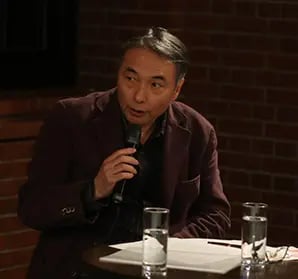
Kuniichi Uno
French literature scholar, critic, and Professor Emeritus at Rikkyo University (Department ofBody Expression andCinematic Arts). His publications include Artaud: Thought and Body (Hakusuisha), Hijikata Tatsumi (Misuzu Shobo), Toward Beckett (Goryu Shoin), Inorganic Life (Kodansha), Paganism (Seidosha), and translations of works such as Deleuze/Guattari’s Anti-Oedipus, Artaud’s To Have Done with the Judgment of God, and Deleuze’s Foucault (all published by Kawade Bunko), as well as Deleuze’s The Fold, Francis Bacon, and Beckett’s Molloy and How It Is (all published by Kawade Shobo Shinsha). His recent works include Hijikata Tatsumi - penser un corps épuisé , Artaud pensée et corps (Les Presses du Réel)