
2024
Jul. 12
Lecture
The Documentation of Dance: From Archive to Exhibition
Kei Osawa
Nov. 16
Symposium
Prohibition, Desire, Transgression — A Misstep Toward the ‘Outside’
Hanako Takayama
2025
Nov. 9
Symposium
In this co-authored book Anti-Dance, we presented the concept of “anti-dance.” However, at least for my part, I consider anti-dance to be dance itself. That said, given the entrenched nature of conventional assumptions about dance, I must begin by stating a rather bitter recognition: the possibility that anti-dance might become the majority form of dance is slim, and anti-dance can only continue to be anti-dance.
My mentor in dance criticism is a man named Nario Goda, whose theory of dance is organized around five key concepts: space, axis, breath, memory, and landscape. Of these, I am currently critical of the last two—memory and landscape—so today I will speak only about the first three: space, axis, and breath. However, these three are not clearly separable in practice, so my discussion will necessarily move between them in a somewhat mixed manner.
Nijinsky’s Axis and Kant’s Subjective Space
When we speak of space in dance, we usually think of scenography—that is, how dancers, objects, and stage design are arranged within a performance space. But what I am referring to is a different kind of space: a bodily spatiality.
As I also wrote in this book, the fundamental “pas” in ballet is based on en dehors, where the legs are rotated outward to 90 degrees. If you try this position, you will understand: it produces a flow in the body that draws energy from the earth upward. In other words, a single axis is created in the body, extending from earth to sky, forming a vertical line between them. The body is structured around this center, and the right and left sides must be geometrically symmetrical around it.
This is one of the core aesthetics of ballet. As Mr. Ochi mentioned earlier, ballet was created in the 17th century under Louis XIV. Therefore, the classical French aesthetic—symbolized by the Palace of Versailles, with its geometrical order—is deeply embedded in ballet. Symmetry, the vertical axis between earth and sky, and the hierarchy that places heaven above earth: through this aesthetic, ballet constructs its space. This remains the basic spatial logic of ballet today, even in Japan. Moreover, ballet has produced far more dancers and audiences than butoh, so its aesthetic remains widely accepted.
Vaslav Nijinsky, who trained in classical ballet in Saint Petersburg and debuted as a prodigious dancer, was fully formed within this ballet aesthetic. However, in Afternoon of a Faun, he departed from it. This choreography has also been performed by Tatsumi Hijikata and Ko Murobushi in various productions.
What characterizes this work is that the body is no longer symmetrical. The chest faces forward, but the face turns sideways. The arms are bent in distorted positions, and the knees are also bent, producing a fractured body. There are various theories about this, including the influence of Cubism. Indeed, it resembles Cubism in the sense that it rejects frontal perspective and collages multiple viewpoints of the body within a single frame.
What is remarkable, however, is that although the body becomes fragmented and disoriented, there remains a strong center, intensity, and axis. This axis is no longer the geometric axis of ballet. Rather, I suspect it is something like what Ko Murobushi repeatedly emphasized in workshops: the figure-eight, or spiral movement. I would call it, quite simply, eroticism—the spiral energy rising from the sexual organs of the body.
This spiral energy, when incorporated into the body, produces an axis that includes torsion. Because it is spiral, the axis is inevitably distorted, but it nonetheless unifies the movement. I believe Nijinsky discovered—or made real—this axis in Afternoon of a Faun.
I began thinking about why such an axis is possible, and one major clue came from the philosopher Immanuel Kant. I will now quote two passages from Kant.
Kant on Space and Orientation
(Prolegomena)
Space is the form of outer intuition of our sensibility, and the inner determination of each partial space is possible only through its relation to the whole space—that is, through its relation to other spaces as parts of a single total space. In other words, parts are possible only through the whole. This cannot apply to things in themselves, but only to appearances.
—Immanuel Kant, Prolegomena
By “pure understanding,” Kant refers to what we would now call scientific or rational cognition.
Even things that are equal and similar internally but do not coincide (such as right-handed and left-handed spirals) cannot be distinguished by concepts alone, but only through their external relation—namely, through intuition such as the relation between the right hand and its mirror image, the left hand.
—ibid.
In another text, What Does It Mean to Orient Oneself in Thinking?, Kant writes:
To orient oneself originally meant to find one’s direction from a given side of the world (which we divide into four directions), especially to find east. If I know it is noon and see the sun, I can determine south, west, north, and east. But for this I require a feeling of distinction within my own subject, namely between right and left. I call it feeling because these directions show no external difference in intuition.
—Kant, “What Does It Mean to Orient Oneself in Thinking?”
When I read this, I was struck.
Roughly 90% of people are right-handed and 10% left-handed, across cultures. Why such asymmetry exists is already a mystery. Even in Tokyo, for example—at Morishita Studio, where we held a workshop for this project—when you exit Morishita Station, the space is extremely geometric, like a grid. In such places, even if you have been there many times, you can suddenly lose your sense of direction. By contrast, in sloped or winding environments, the body tends to remember the space more easily.
This suggests that the asymmetry between right and left is fundamental to bodily experience.
Kant argues that spatial perception is grounded in this bodily asymmetry. He calls it “feeling”—not merely feeling in the emotional sense, but something more fundamental, closer to affect. It is a bodily sense of orientation.
This idea resonates deeply with me. Space is not simply objective geometry; it is structured by bodily orientation. Kant also states that although right and left are identical in form, they are irreducibly distinct in bodily experience. This cannot be resolved in two dimensions; it requires a higher-dimensional transformation, something like a Möbius strip or a figure-eight twist.
Kant and Nijinsky are separated by more than 150 years, but Kant’s idea of subjective space already presupposes the classical geometric space of modernity. He does not deny it; rather, he argues that while objective space exists as a thing-in-itself, the space experienced by each body is different from it.
We live within these individually structured subjective spaces. This Kantian intuition, which is one of the earliest articulations of modern thought, seems to me to become partially revealed in Nijinsky’s dance 150 years later.
Alberto Giacometti and Spatiality
As another reference for axis and space, I would like to mention Alberto Giacometti.
At Shy, there is a photograph of Giacometti’s sculptures and him at work. I once heard from Murobushi in conversation that “sculpture ends with Giacometti,” and I believe Giacometti was also extremely important to him.
Jean-Paul Sartre wrote about Giacometti’s work in his text The Search for the Absolute:
Against classical sculpture, Giacometti restored to statues an imaginary space without parts. He discovered the absolute by fully embracing relativity. He first conceived of sculpting the human being as seen from a distance. He gives his plaster figures an absolute distance—figures at “ten steps” or “twenty steps.” And yet, wherever you stand, they remain there, and suddenly they leap into unreality.
—Sartre
Sartre argues that Giacometti’s elongated figures revolutionize sculpture. Unlike painting, where distance is framed, sculpture normally changes with physical proximity. But Giacometti’s figures remain distant regardless of approach.
This is because Giacometti constructs not physical space, but an imagined spatial field surrounding the sculpture in 360 degrees. His work creates an artificial stage, an imagined spatiality. Sartre even says Giacometti “creates emptiness.”
And yet, each sculpture still has a clear axis—thin, fragile, but unmistakably present.
From Nijinsky to Hijikata and Murobushi — Dance as Vacuum
I would now like to move from Nijinsky to Hijikata and Murobushi.
Nijinsky seems to have acted largely on intuition. Hijikata and Murobushi, however, seem to have taken up his gesture in a more methodical way. Murobushi himself wrote that if Nijinsky had systematized his intuition, he might not have fallen into madness.
In Murobushi’s technique, two things are crucial: the convulsion of the bodily axis and breath. Breath here is something close to absence—it circulates endlessly between inside and outside, repeating continuously.
Breath is closely tied to spiral movement, the figure-eight. It is also connected to eroticism. In Murobushi’s dance, eroticism transforms into breath. This condition produces what I would call a vacuum state of the body. At the same time, the bodily axis becomes exposed in an extreme way.
This vacuum is essential.
To think further about this “dance vacuum,” I find the artist Natsuyuki Nakanishi particularly important. In the 1960s, he played a role almost like a dramaturg for Hijikata, contributing conceptual suggestions that shaped butoh practice.
In his text “Repair and Revenge,” Nakanishi discusses bellows (fuigo), breath, and metallurgy. This connects to an idea of artificially producing air and working with compressed matter. There is also a famous exchange in which Hijikata suddenly speaks of “vacuumed metal.”
Vacuum, then, is not absence but extreme density of space. Paradoxically, creating vacuum invites air. The collapse of breath leads to its return. This is not metaphorical but physically real.
Breath becomes the mediator between inside and outside, especially when language is involved. Michel Foucault’s “I speak” suggests that language produced by the self becomes external to the self, a material outside. Breath mediates between this externalized language and the body.
Axis, Soccer, and Dance Space
To explain axis more concretely, I often think about soccer.
At its core, soccer is the reading of bodily axes between players. The most basic technique is feinting—pretending to go right and suddenly going left. A defender cannot respond because their body is structured by an axis.
Penalty kicks are an even clearer example: goalkeeper and striker engage in a reading of each other’s axis. Whoever commits first loses. The body cannot shift easily once weight is committed.
In this sense, soccer players may actually understand bodily axis more deeply than many dancers.
On Space, Fourth Walls, and Anti-Dance
Butoh is often misunderstood as a collapse of boundaries between performer and audience, or as a festival-like communal space. However, this is not what I mean by spatiality.
The space I refer to is not a fusion of performer and audience. There remains distance. But within that distance, a totality emerges, created by the dancer’s body.
Sometimes the dancer’s body “enters” the spectator—not physically, but imaginatively. It is a kind of bodily contagion, even a form of erotic charge. But this is not festival-like dissolution of boundaries; it depends on the spectator’s imagination.
Anti-Dance as Latent Space
Another key point: anti-dance is a latent space.
What I find boring is a dance whose movement is already predetermined, where only one possible trajectory exists. In contrast, anti-dance reveals multiple possible trajectories behind a single chosen movement.
It shows the dancer’s selection among possibilities. It also rejects frontal representation. Murobushi’s body is not frontal but 360 degrees—front, back, and all directions simultaneously latent.
One key difference is that Murobushi does not use facial expression. This rejection of the face is also a rejection of frontal theatricality, allowing a 360-degree spatiality to emerge.
Breath as Transgression and Resistance — Canetti and Kakizome Takuzo
Finally, I would like to end with Elias Canetti.
In his “Hermann Broch Memorial Lecture,” Canetti speaks of breath as a form of transgression. He writes:
Broch’s transgression is breathing.
Breathing becomes resistance to systems of violence. It is a form of disobedience.
He describes air as the last common property, equally distributed to all. Even in starvation, one still breathes until the last moment.
Yet this shared air is also becoming toxic. We feel it without fully perceiving it.
Breathing, then, becomes a form of resistance.
I would also like to mention Kakizome Takuzo, a performance artist who continued hanging performances in his garden. In his writing on butoh, he once described breathing as something tied to guilt and punishment in the city.
After reading Canetti, I recalled his words. Perhaps his obsession with hanging was also a way of constructing a simulated death in order to make us recognize, paradoxically, that we are still breathing.
(Translated into English by ChatGPT)
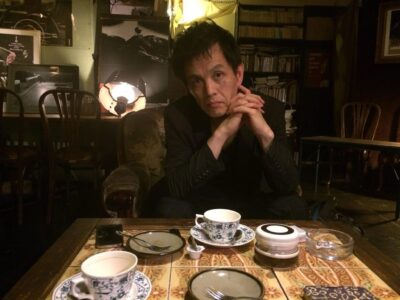
Born in 1965, he studied French literature at the University of Tokyo and became interested in dance after discovering Maurice Béjart and Antonio Gades through cinema. In 1989, he encountered Butoh. Since 2006, he has been working as a dance critic. His interests include developing new philosophy from the viewpoint of the body and the specificity of Butoh, grounded in contemporary philosophy and Japanese medieval Buddhist thought.