
2024
August 24
Workshop
Nov. 24
Symposium
Nov. 24
Symposium
2025
Nov. 9
Symposium
Dec. 27
Symposium
Dec. 27
Symposium
My research moves between two poles. My PhD was dedicated to the thought of the Outside in the work of the writer and dancer Ko Murobushi. My current book project for Reaktion Books examines the political bodies in the work of the poet and filmmaker Pier Paolo Pasolini.
This double perspective led me to a simple but productive question: What happens when you intercross these two artists and writers who both thought relentlessly about the body at the margins?
This lecture explores how two radical artists turned the socially rejected body into a site of aesthetic and political defiance. While their mediums and cultural contexts diverged, both Pier Paolo Pasolini and Ko Murobushi were drawn to figures at the margins—not to represent them, but to inhabit the very condition of being an outsider.
Pier Paolo Pasolini sought the sacred in the bodies of Rome’s subproletariat: the thief, the prostitute, the ragazzo di vita. Filming them with the gaze of a poet-hagiographer, he elevated them to the status of modern saints. In his novels, poetry and films he fought to preserve the vanishing world they embodied—their dialects, their gestures, their pre-consumerist vitality. His work mourns what he called a “cultural genocide”—the erasure of these social outsiders by consumer capitalism. With the death of the communist leader Palmiro Togliatti in 1964, Pasolini’s belief in Marxist utopia collapsed, deepening his turn toward a cinema of myth, sacredness, and, finally, apocalyptic despair.
Ko Murobushi inherited an embodied legacy of social defiance in Tatsumi Hijikata. Pasolini and Tatsumi Hijikata both grew up in rural, war-shattered societies, in the rubble of the post-war era. Pasolini grew up in the countryside in Italy without electricity, Hijikata in starving post-war Japan. When they first moved to the metropolises from the northern, outlandish areas, they both lived under challenging conditions of poverty in a world of hunger and petty crime.
As Akiko Motofuji said, Hijikata lived as a thief. He wrote about this in his manifesto “To Prison“ (1960) expressing a certain disappointment at never having had a prison experience like his idol, Jean Genet. This is the very lineage of the criminal outsider that Ko Murobushi inherited. Hijikatas lived experience of criminality and precarity became the somatic foundation of Butoh.
Pasolini and Hijikata experienced, within just a few years, the very fast, brutal, and disorienting leap into modernity – and they existentially suffered because of it.
Hijikata framed the dancer as “a criminal in a production-based world.” To fund this criminal art, Murobushi performed in erotic cabaret and fire shows, selling the spectacle of his own flesh to finance Hijikata’s experiments and his own performances.
In several feature films Murobushi made with Hijikata, the subject was criminality and criminal gangs. Hijikata and Murobushi were also collaborating on a grotesque Horrorfilm in which Hijikata acts in the role of a mad scientist, who lives isolated as an societal outsider on an island and wants every human to become a monster. Here, the criminal and the monstrous were not just concepts, but cinematic anatomies. Murobushi’s entire practice can be seen as a curation of outsiderhood. Between 1974 and 1978, he edited the Butoh magazine La saison violente, whose title was adapted from Rimbaud. In a now-iconic group portrait of the Butoh group Dairakudakan, he posed its members not as artists, but in the stark, formal aesthetic of a yakuza clan photo—men in white shirts, suits, and ties, their hands hidden, their expressions inscrutable. For him, the magazine itself was a dance, an event of becoming.
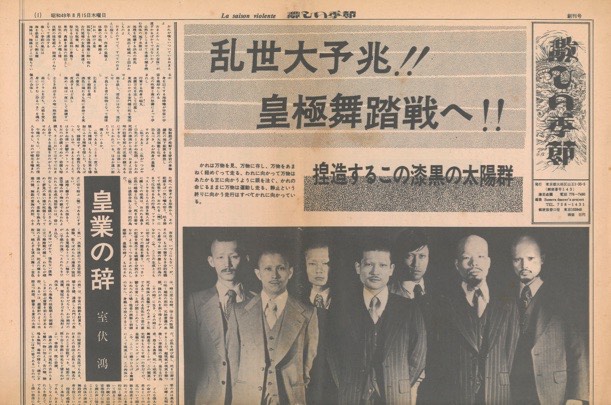
He engaged deeply with a personal taxonomy of exclusion: the oni (demon), the yamabushi (the stateless mountain ascetic), the dancer, the criminals of Genet’s novels, the monster, the the acephalic, headless body of Bataille and many more. This was not merely theoretical. His practice was a direct embodiment of the literature of the Outside, transforming text into trembling flesh. He sought to dissolve into a monstrous, fascinating exteriority: “A monster that is repulsive; yet, at the same time, rejection also functions as attraction and allure. I want to become the monster that is rejected and alluring.”
Intercrossing their work reveals two distinct modes of political embodiment: Pasolini documented and mourned the historical outsider as a vanishing sacred form. Murobushi performed and weaponized outsiderhood as a dance of resistance.
Together, they remind us that the margins are not merely a location of exclusion, but a territory of imminent and immanent potential transformation—where the monster, the saint, the criminal and the dancer meet in the body that society refuses.

Romina Achatz, PhD, is researcher, essayist, filmmaker, dancer and radio producer. Her research engages with body politics, feminist theory, and visual culture, focusing on marginalized corporealities, performative practices, de-subjectivization, and the aesthetics of the impersonal. She holds a PhD in Cultural Studies, with a dissertation on the dance of Ko Murobushi. Her essays and lectures address themes at the intersection of performance and critical theory.