
2024
August 24
Workshop
Nov. 24
Symposium
Nov. 24
Symposium
2025
Nov. 9
Symposium
Dec. 27
Symposium
Dec. 27
Symposium
I’m very grateful to Kimiko Watanabe for inviting me to participate in the events devoted to Ko Murobushi in July this year in Vienna, and now also for this presentation at Café Shy, and I’m only sorry she is not able to be here today.
I’m going to speak here about my meetings and dialogues with Ko Murobushi in London over three evenings in March 2004, so over twenty years ago now. Those dialogues focused notably on our shared preoccupation with the work of the French artist & theorist Antonin Artaud – as well as on Ko Murobushi’s own work and on his association at the end of the 1960s with Tatsumi Hijikata, notably Ko Murobushi’s evocation for me of witnessing Hijikata’s solo performance at the Osaka World Exposition in 1970, which I then later researched at the Exposition archives in Osaka.
I recorded those dialogues in London in handwritten form, in several notebooks, not as sound recordings, because the three evenings of meetings took place in a noisy restaurant, the ‘Tas’ Armenian restaurant in a street called ‘The Cut’ in London, very close to where Ko Murobushi was conducting a week-long workshop.
In July this year, for the Ko Murobushi symposium which took place in Vienna at the Odeon Theatre, I searched for those notebooks for the first time in twenty years, and I found the content very illuminating and unusual. So, in those notebooks, I had transcribed what Ko Murobushi said to me about Artaud’s work, but it was recorded in the form of fragments: short sequences of dialogue, or reflections. And also in a form in which: translation itself was a pivotal element, since Ko Murobushi had to translate his thoughts on the work of Artaud for me, from Japanese to English, directly as he was speaking, since I could not speak Japanese.
This element of translation is also pivotal for the future published form of these dialogues, because the Berlin-based publisher Diaphanes will begin to publish a sequence of five or six short books in English, about Ko Murobushi’s work, each of about 100 pages, starting in 2026.
The first book, which Kimiko Watanabe has assembled, will be titled: Fierce Unworking, and it’s a selection in English translation of Ko Murobushi’s notebook or journal writings, which, as you all know, were already published in a large-scale volume here in Japan. So, my own book will form the second book in that English-language series, and will focus partly on those dialogues with Ko Murobushi in London about the work of Artaud, especially Artaud’s final radio work of 1947-48, titled Pour en finir avec le jugement de dieu, ‘To have done with the judgement of god’, which in its final section concerns a reinvention of the nature of dance, and contains the celebrated evocation of a: ‘body without organs’ – ‘corps sans organes’. And Romina Achatz will contribute a further book in this series, drawn from her extensive research here at Café Shy and her own dialogues with Ko Murobushi. So, the intention of this forthcoming series of short books in English will be: to deepen understanding in Europe of Ko Murobushi’s work, and also to initiate new dialogues and new research about it…
So, for this presentation, firstly I’ll speak about how Ko Murobushi’s association with London became such a prominent location for his work: how he came to perform and give workshops so often in London between the years 2001 and 2015, as part of his constant ‘itinerance’, as a travelling choreographer, to Europe as well as to countries such as Mexico.
Secondly, I’ll speak about our meetings over three nights in 2004. These were the only intensive dialogues I ever had with Ko Murobushi, and otherwise I only ever spoke to him very briefly, for example, for the last time when he performed at Treptower Park in Berlin, in 2014, the year before his death. So, as I said, those dialogues over three nights began with his memories of his work as a young dancer, with Tatsumi Hijikata, and then shifted into a dialogue focused on the work of Artaud.
Thirdly, I’ll speak briefly about my own research in Paris into the work of Artaud around the beginning of the 1990s, when I investigated that radio work which appeared to be a special focus of Ko Murobushi’s interest in our dialogues, alongside other elements of Artaud’s work. During my research in Paris, I had met several of Artaud’s collaborators in that radio work, as well as the work’s radio producer.
And finally, I’ll focus on what Ko Murobushi and I discussed about Artaud’s work, specifically elements of that radio work, Pour en finir avec le jugement de dieu, with its focus on: demands for the creation of a reinvented form of dance that will transmutate the human anatomy, and which will exact a ‘reparation’ against the social and psychiatric entities or powers that had incarcerated Artaud for the nine years, 1937-1946.
At the time of those dialogues with Ko Murobushi, in London in 2004, I had no intention of assembling a book from those encounters, and so their handwritten trace in my own notebooks is fragile, fragmentary, ephemeral – but perhaps such a trace forms an ideal medium of memory, for evoking the nature and anatomical reconfigurations of dance. And it’s really only through the vital encouragement of Kimiko Watanabe that this book will exist.
So, everyone here knows that Ko Murobushi was an itinerant choreographer, constantly travelling, including a long residency in Paris. And that his death in 2015 in Mexico City took place within the course of his travels. So it’s for sure that these incessant itinerant travels formed a pivotal element of Ko Murubushi’s work. At the Ko Murobushi symposium in Vienna in July, I met numerous researchers and choreographers who had been the organisers or instigators of Ko Murobushi’s travels, such as Katja Centonze, who invited him many times to Italy, and other figures who invited him to Budapest, Vienna and other cities. One manifestation of those travels is the: filmic documentation of Ko Murobushi’s performances in those many cities, archived here at Café Shy. Another manifestation is the presence in Ko Murobushi’s journals or notebooks of: fragments written about the cities he is passing through, often directly alongside evocations of his current ongoing readings, of writers and philosophers: Mallarmé, Nietzsche, Blanchot, Deleuze.
But my focus here is on London, since that city was such a frequent destination for Ko Murobushi’s travels, and that was also where our dialogues took place.
So in July this year I met in London with the person who invited Ko Murubushi many times to that city, from 2001 to 2015, and I asked her to tell me her memories of that time. So this person is called: Marie-Gabrielle Rotie. During those years, she was herself a dancer, engaged with butoh, but now, she stopped dancing, and she is a professional choreographer of feature films. For example, she choreographed the 2024 film Nosferatu of the film director Robert Eggers, which draws directly from her extensive work with Ko Murobushi. And she is currently choreographing another film with that same director Robert Eggers, titled Werewulf. So, about this direct transmission of her collaborative work with Ko Murubushi into the medium of feature films, Marie-Gabrielle Rotie told me: ‘Ko’s work with animal/human transformation is legendary and unsurpassed.’
Now I’ll read a short account of how Marie-Gabrielle invited Ko Murobushi to London, many times. She told me: ‘I met Ko in 2001 when he first came over to teach for my organisation, ‘Butoh UK’. This then established a creative and producer relationship between us that continued up to his death. The first performances at the Place Theatre in London happened in 2003 and the director of the theatre was convinced I was taking a [big] risk booking out the theatre for two nights. I paid for the venue on my credit card. As it transpired, both evenings were sold out. So I definitely got my money back!… We took the touring to the Colston School in Bristol [Bristol is a city in the west of England]. I will never forget the young audience (all aged 12 to 16) being absolutely mesmerised by Ko Murobushi…. especially the force of his energy to transform any notion of physical stature. As one schoolchild noted, Ko had the most magical feet, very tactile and sensate…. I last saw Ko in May 2015. He was performing some improvisations at the Tate Modern art-museum in London for an event choreographed by Boris Charmatz. He told me he was: ‘facing death’. I took this on a metaphoric level. Although his physical struggles to move seemed too real on this occasion. He knew his time was near, and a few weeks later he died…. In the last workshop I had produced for him, at the Buddhist Arts Centre in London’s Bethnal Green district, in 2014, I practically had to drag him away from long cigarette breaks. In that workshop, he seemed to be in a real crisis about butoh and teaching. He kept saying: ‘I am not butoh’, or: ‘butoh is dead’, or: ‘I am no longer a butoh dancer’. It was both painful but also funny, having to persuade Ko to teach the room full of 20 eager participants… Now, finally, I carry Ko’s memory as a ghost.’ (That’s the end of what Marie-Gabrielle Rotie told me.)
So, what I took from Marie-Gabrielle Rotie’s account of Ko Murobushi’s visits to London was that there existed a very deep engagement of young dancers in that city to attend his workshops, but also that he had a huge public audience for his performances in London. I myself attended those two performances at the Place Theatre, which is a very large auditorium, and the response there to Ko Murobushi’s work was one of extreme and intense concentration and appreciation.
So, next I’m going to speak for a moment on what Ko Murobushi told me about his time working: as a collaborator or assistant with Tatsumi Hijikata, for a period at the end of the 1960s. So, Ko Murobushi was around 22 years old at this time. He had visited Hijikata at his Asbestos studio in Meguro district for the first time to ask if he could train as a dancer with Hijikata, but Hijikata immediately then asked Ko Murobushi if he was ready for: ‘other work’. They worked together on cabaret performances, and on erotic and grotesque-horror films. Ko Murobushi told me also that he had witnessed Hijikata’s one live performance at the Pepsi-Cola pavilion at the 1970 Osaka World Exposition (‘Osaka Banpaku’). Before Ko Murobushi told me in London in 2004 about this collaboration at the end of the 1960s with Hijikata, I knew nothing at all about it – except for what Hijikata’s widow, Akiko Motofuji, had previously said to me about her own role in being the ‘manager’ of that cabaret and film work. But I’ve since had the chance to see all of the films of that era in which Ko Murobushi appeared, and also visited the Exposition research centre in Osaka, thanks to the director & staff of the Hijikata archive at Keio University Art Center. Very little archival trace survives there of that performance by Hijikata, so it appears that Ko Murobushi’s eye-witness account was a valuable one.
So, Hijikata’s solo performance took place as a ‘preview’ event for the Pepsi-Cola pavilion on the evening of 11 March 1970, shortly before the Exposition officially opened. Ko Murobushi told me that he watched the performance from the side of the auditorium, which was covered entirely in foil mirrors whose reflections inverted the bodies of spectators. He told me specifically that he had his spine tightly pressed against the side of the pavilion as he watched the performance.
I was very intrigued by what Ko Murobushi told me about this performance by Tatsumi Hijikata that took place in 1970 at the Osaka World Exposition, and I wanted to find out more about it. But this did not happen for fourteen years, until 2018, when the Hijikata Archive directors, Kosuge-san and Morishita-san, arranged for me to visit the Exposition archive and research centre, which was then not usually open to researchers. Since that was in 2018, it was after the death of Ko Murobushi in 2015, and I never had the chance to speak again to him about it. But I’ll give a short account now of that performance, because it appears a very unusual one in the wider context of Hijikata’s work, and I included this research in a book that was published in 2019 about Hijikata’s collaborations with filmmakers… Hijikata had also appeared in a film projected in another pavilion of the Osaka World Exposition, the Midori-kan. That film was shot on a volcanic mountain in Hokkaido in 1969. It was projected to around 8 million Exposition spectators. And that film still exists, in deteriorated condition, at the Hijikata Archive here in Tokyo. But I did not speak with Ko Murobushi about that film, only about the live performance of Hijikata at the Pepsi pavilion. So, I’ve combined here what Ko Murobushi told me, together with other dialogues, including with the architect Arata Isozaki, and also what I saw on my visit to the Osaka Exposition Archive. I also received other eye-witness accounts of the interior of the Pepsi Pavilion, such as that of the performance historian, Tadashi Uchino, who visited that pavilion, the Pepsi-kan, at the age of 12, on a school trip.
Many prominent artists from Japan and other countries participated in the Exposition, partly because it was very well-paid to do so. But the Pepsi Pavilion itself was not situated on the main site of the Exposition grounds, where the national pavilions were situated, together with the Midori-kan, where Hijikata’s film work was projected. Most pavilions at the Exposition were in the form of large ‘dome’ constructions, most of them using a model designed by the young Italian architect Dante Bini, whom I also interviewed for this research. The Pepsi pavilion was situated in an annex to the main site, titled ‘Expo-Land’. Many visitors never entered that annex site, so the pavilions had to be very spectacular in order to attract visitors. The Pepsi pavilion was designed by an artists’ group based in New York City that was prominent at that time, known as: ‘Experiments in Art and Technology’. The Official Report of the Exposition provides an account of the spatial environment in which Hijikata gave his performance, as follows: ‘The inner world of the dome was made of mirrors of vacuum-deposited aluminium foil which had been sandwiched between polyester and a coating…/Some 2,500 jet-spray nozzles connected with nine pumps were arranged symmetrically along the exterior ridges and constantly generated an artificial fog./The artificial fog became a cloud which hung over the building and presented a fantastic feeling at night when illuminated by white beams shining from Xenon lamps./When the visitors descended the tunnel-shaped stairway from the entrance to the interior of the Pavilion, each one received a small handset from a silver-suited hostess./The handset was used to lead visitors to a new world of experience.’ So, that exterior water-based fog environment was created by the celebrated artist Fujiko Nakaya, and the pavilion’s internal sound-environment was by the musician David Tudor.
The pavilion and its planned events programme were initiated entirely for profit by the Pepsi-Cola Corporation, with the aim to promote a corporate arts agenda. This is clear from the speech given by the President of the global Pepsi-Cola Corporation, Donald Kendall, at the official opening of the pavilion, three days after Hijikata’s performance, in which Kendall declared: ‘We believe that the Pepsi Cola pavilion will set a precedent in new corporate participation in the arts.’
So, Hijikata’s performance was a preview event for the Pepsi Pavilion, for an invited audience, including the international corporate executives who had arrived in Osaka for the pavilion’s opening, and it was not intended for a public audience. As far as I know, it was not filmed or photographed, or if it was, those documents are currently lost.
From what Ko Murubushi told me, Hijikata’s solo performance lasted for 30 minutes, and was announced with the title Adagio; it involved frequent collisions of Hijikata’s body with hanging metal panels, as in his celebrated performances of the preceding years. Dilapidated wedding-robes hung from hooks, from the dome’s summit. The high-volume sound – funeral chants, a thunderstorm, and the cawing of crows – generated cacophonies in the pavilion’s environment, which served to magnify the sound level.
Ko Murobushi said nothing at all to me about the response to the performance of the Pepsi-Cola executives, but it’s very clear that it was: negative, since they cancelled the entire programme of events scheduled for the six-month duration of the Pepsi pavilion, which had included, among others, works by Shuji Terayama, and many further performances by Hijikata. Instead, they replaced the performances with sessions of: ‘go-go dancing’ and ‘outdoor rock dancing’. So, Hijikata’s live participation in the Osaka Exposition, witnessed by Ko Murobushi, was not a success, while Hijikata’s filmic participation, with experimental cinematic projections, in the Midori pavilion, by contrast proved to be a great success.
I’ll now go on to talk about my research in Paris into Artaud’s radio work of the end of the 1940s, before then focusing on my discussions of it with Ko Murobushi in London.
Artaud’s radio project Pour en finir avec le jugement de dieu was completed and ready for transmission, but was then censored by the French national radio station, and it was not broadcast to its expected audience of one million auditors. Here is an extract from it, in which you can hear Artaud performing screams and making percussion noises. [from 27 minutes, 20 seconds]
So, in the course of five years of research in Paris in the first half of the 1990s, I was able to speak with many of Artaud’s surviving collaborators, who had been very young, in their 20s, when they had worked with Artaud in the 1940s, including two of the three participants with Artaud in that radio work that I mentioned: so, Paule Thévenin and Maria Casarès. (The other participant, Roger Blin, had already died by that time.) I also met many times with Artaud’s psychiatrist, the director of the Rodez psychiatric hospital, Gaston Ferdière, who administered many electroshock treatments to Artaud, and that psychiatrist is denounced and attacked in Artaud’s radio work. In Paris, I also met many artists and philosophers who were preoccupied with Artaud’s work and had experienced direct contacts with him, such as Chris Marker and Jean Baudrillard.
Later, in 2006, I also spent an entire year at the Bibliothèque Nationale, the national library in Paris, reading the manuscript notebooks, or ‘cahiers’, over 400 of them, which Artaud used as his principal working medium in the last years of his life – and which comprise, in some ways, a parallel to Ko Murobushi’s own itinerant notebooks and journals that are archived here at Café Shy. So, Artaud developed the content of his radio work in the form of texts written in those notebooks, before then transmitting it into a vocally recorded form.
Another area of research I undertook in connection with Artaud’s radio work was to locate two interviews which he gave to newspaper journalists in the very short interval between the censorship of his radio work, and his subsequent death in the following month, March 1948. In those two interviews, with the Figaro and Combat newspapers, Artaud is furious that his radio work has been censored. He speaks about: ‘my notorious radio broadcast that went missing’. In those interviews, he remains focused on the elevation or reinvention of dance and corporeality that is also emphasised in his radio work: In the first interview, he tells the journalist: ‘- What I’m telling you is that we have lost a particular conception of the human being… All that counts is the human body… Right now, I want to destroy my thought and my mind… Above all, to destroy thought, mind and consciousness; I don’t want to suppose anything, admit anything, enter into anything, discuss anything…’. In the second of these newspaper interviews about the censorship of his radio work, Artaud reflects on the zone of tension or collision between language and corporeality, which is where he situates his vision of dance. The last words of that second interview are: ‘- I am haunted – for a long time now – by a kind of writing which is not within the norm. I’ve wanted to write outside of grammar, to find a means of expression beyond words. And now and then I’ve believed myself to be very close, to that kind of expression… but everything is driving me backwards.’
At the time when I was researching Artaud’s work in Paris, at the beginning of the 1990s, his radio work was still difficult for the public to access. Artaud’s collaborators and friends had cassette copies of it, and it was possible for me to hear the original recording itself in the radio station’s archive. But, ten or twelve years later, in 2004, at the time of my meetings with Ko Murobushi, the situation had changed entirely with the development of internet media, so that radio work was by then widely accessible.
This part of finalmy presentation is more tentative or exploratory material, because I have not yet transcribed the dialogues with Ko Murobushi on Artaud’s radio work, and in many ways, they appear enigmatic. But I will do that next, and hopefully this book I’ve described, on Ko Murobushi in London, will then be published in 2027.
So, I discussed this radio work of Antonin Artaud with Ko Murobushi in London, and from the notebooks that recorded our dialogues, this appears to have been the main preoccupation of the third and final evening of dialogues we had there, in the ‘Tas’ restaurant, before he left London on his itinerant travels. It seemed that Ko Murobushi had read the Japanese translation of a book I had written on Artaud, titled ‘Blows and Bombs’, which was published by Hakuisui-sha in 1995. That book focuses notably on the context of Artaud’s radio work, alongside other works of his final years. As is clear from Ko Murobushi’s journals, and from the contents of his personal library, preserved here at Café Shy, he had a strong, enduring engagement with Artaud’s work.
The final radio work of Artaud is, in many ways, a vocal demand for: ‘reparation’. As I mentioned, the work was censored and prohibited, so that call was silenced, at least for the time of its intended radio transmission. So, exactly what kind of ‘reparation’ is Artaud demanding? Firstly, he evidently demands the end and erasure of the psychiatic-hospital system of France in which he spent nine years. More than that, he demands the end of all power invested in doctors, and the overturning of the relationship between doctors and patients. Alongside that, he demands the end of society, of religion, of warfare. For himself, his demand for reparation in the final phase of his life was also financial. He invented the existence of a bank account at the Bank of France which contained vast sums of money, and then insisted that his friends, such as the artist Jean Dubuffet, go to that bank and locate that enormous sum of money that had been withheld from Artaud. He demanded the return to him of great quantites of drugs, of narcotics, especially morphine, that also had been withheld from him. But above all, his demands for ‘reparation’ focused upon the human body itself. Artaud perceived his body as existing under acute threat, from assassins and from malicious agents of society.
But Artaud’s reparation of the body will be a corporeal transmutation that is entirely undertaken by himself. He is not demanding help from anyone that his body is returned to him, such as, for example, help from his radio work’s expected one million listeners. He will seize back his own body, for reparation.
And that act of reparation will happen through: dance.
Artaud was a writer, visual artist and theatre director, but he was not a dancer, he never directed dance performances, and had only ever made lighting designs for public dance performances in the 1930s. But, in a contrary way, the main focus of his radio work, in its final sequence, is uniqely upon dance: a re-conception of dance in conflict with the current human anatomy.
It was especially in the last minute or so of Artaud’s radio work that he focuses on dance.
So I saw from my notebooks that there were three particular points of focus upon dance that I discussed with Ko Murobushi.
Firstly, Artaud declares that the body has to learn to dance backwards, back to front, inverted – à l’envers (in French) – in order to return to its primary combative state, in which it is able to resist assassination or erasure. So, is this what we see in many manifestations of butoh dance, from the end of the 1950s with Hijikata’s first performances, up to now? The ‘wrong-way-round’ body? Certainly, Ko Murobushi appeared deeply engaged with this phrase in our discussion of it. Is Ko Murobushi’s dance a ‘wrong-way-round’ dance?
Secondly, Artaud declares that his envisioned dance will resemble, as he says: ‘the delirium of dance halls’, or specifically, in French, the delirium of the ‘bal musette’ – this is a very distinctive form of dance hall, with wild accordion music and wild dancing, that was hugely popular in Paris at the moment when Artaud made his radio recording in 1947-48. From his time living in Paris, Ko Murobushi was certainly familiar with that kind of dance hall, or with its more contemporary manifestations of the 1980s when Ko Murobushi was based in Paris. When Artaud speaks of the bal musette, he’s certainly appealing directly to his intended audience of one million auditors, many of whom would themselves be habitual dancers in such popular dancehalls. In the letters that Artaud wrote to friends about this radio work, he made it clear he wanted that work to be heard by a mass audience, including, as he wrote, ‘roadmenders’: manual workers. So, he’s envisioning an act of dance which is a ‘mass’ dance, not only a solitary or solo dance.
And there was one other moment in this radio work which appeared to deeply engage Ko Murobushi, in our discussions of it. So, when Artaud evokes the transmutation of the human anatomy that will enable it to dance in the way that he envisages, as the ‘body without organs’, he sees that act as involving a violent or radical process. So, Artaud declares that the human body needs now to be placed on an: ‘autopsy table’ to be re-made, in order then to dance. The body has, in Artaud’s vision of it, initially been badly created and badly made – by a malicious god – and it now has to be violently re-made, re-invented, gouged-out and eviscerated, in order, then, to dance. But it’s the dancer themself, nobody else, who has to undertake that self-directed autonomous act which will take place on the ‘autopsy table’, an act of self-autopsy, then, in a space simultaneously alive and dead.
So, is that act also resonant of Ko Murobushi’s approach to dance?
I would like to know: can we now, or ever, reach the interior of Ko Murobushi’s thinking, and reach into his intensive work on the human body, in dance? His response to the radio work of Artaud is just one transit or aperture into that interior, but it appears potentially a deep and direct one.
And what I’ve presented here is, as I said, very tentative, as work in progress for the future book I mentioned: looking, in an exploratory way, across the bodies of work – of Artaud and of Ko Murobushi.
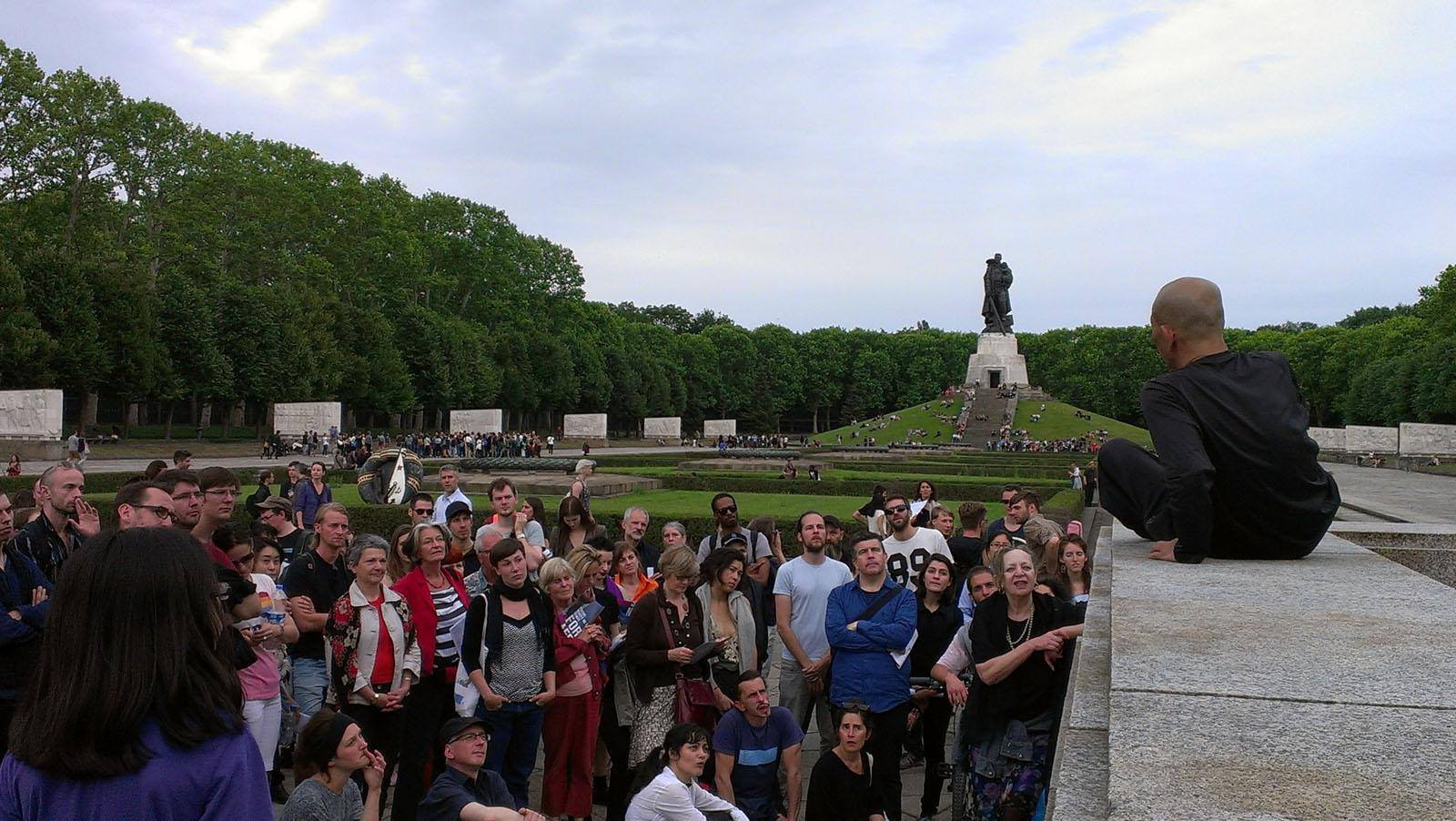
And finally, and very briefly, I’m going to evoke the very last time I saw Ko Murobushi perform, in Berlin, in 2014, that performance which I’ve already mentioned. He performed an outdoor work, which he announced as concerning: Hijikata’s death, and which took place on the exterior surfaces of Berlin’s Treptower Park war-monument, whose immense granite constructions and steles – with texts written by Stalin – are positioned above vast burial-sites of the young USSR war-dead, killed during the assault on Berlin in April 1945.
Ko Murobushi gave an improvised performance twice, each time for around 20 minutes, and sat in-between on a bench alongside the memorial steles, calmly smoking cigarettes. A crowd of around 40 people surrounded each performance, but nobody appeared to be filming it, perhaps through the spectators’ intimacy with Ko Murobushi’s figure, or else through the ocular and sensory attention demanded for the performance. Ko Murobushi performed on the edge of one of the memorial’s granite surfaces, while evoking, in intermittent vocal outbursts, in English, his perception of proximity to death: proximity to Hijikata’s death, to the deaths of the figures in the subterranean burial-vaults directly below him, to his spectators’ deaths, and to his own death, still in the near future. The spectators moved still closer to catch what he was saying, and I attempted to note it down (since otherwise it would be lost forever). So, this exactly is what I wrote down: ‘‘In his own death, in dancing, Ko Murobushi is thinking of someone who has died, Hijikata, and his dance should now project a plethora of dead bodies, or spectres, or ghosts, that are unable to move, or to manifest themselves, except through that dance, his own dance, those ”presences of the dead” expelled from their usual incapacitation, into this space, into Berlin, via the medium of his body, which simultaneously resists those spectres of the dead, but also serves as a kind of opening or aperture for them, back into the world.’’
Thank you very much for listening.
Stephen Barber is a writer, and a professor of art and film at Kingston School of Art, Kingston University in London. He has written many books, most recently White Noise Ballrooms and Into the Wastelands. He has also written a book on Tatsumi Hijikata’s collaborations with filmmakers in 1960s Tokyo, Film’s Ghosts.